Popular Posts

Saturday, 17 June 2017

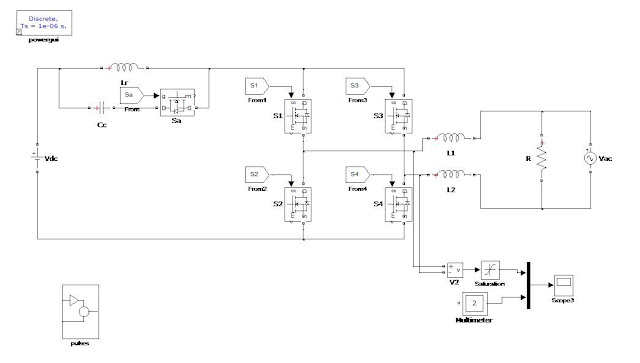
A ZVS Grid-Connected Full-Bridge Inverter With a Novel ZVS SPWM Scheme

Abstract—

A zero-voltage switching (ZVS) grid-connected full-bridge inverter and its modulation schemes are investigated. A novel sinusoidal pulse width modulation scheme for the ZVS full-bridge inverter (ZVS SPWM) is proposed in this paper. The ZVS SPWM is evolved from the double-frequency SPWM by adding gate drive to the auxiliary switch. The ZVS condition is analyzed and the circulation loss of the resonant branch is optimized by adjusting the energy storage in the resonant inductor. The reverse recovery of the body-diode of MOSFET is relieved and ZVS is re-alized for both main and auxiliary switches. The filter inductors are significantly reduced with higher switching frequency. The design guideline of resonant parameters and the implementation of ZVS SPWM in DSP controller are introduced. The ZVS SPWM scheme is verified on a 3-kW inverter prototype. According to the experimental result, peak efficiency as 98.8% is achieved.


An Open-Switch Fault Diagnosis Method for Single-Phase PWM Rectifier Using a Model-Based Approach in High-Speed Railway Electrical Traction Drive System

Abstract—

The converter with a single-phase rectifier, a dc-link circuit and a three-phase inverter is widely applied in high-speed railway electrical traction drive system. The fault frequency of single-phase rectifier is higher than that of three-phase inverter. Thus, this paper presents a new and fast model-based approach for open-switch fault diagnosis of the single-phase pulse width modulation rectifier, based on the mixed logical dynamic model and residual generation. It requires no additional hardware but only some measurements and command signals which are available in control system. This diagnosis method is quite suitable for electrical traction application due to the fast diagnosis time, simple structure and high reliability. Experimental results confirm the effectiveness and accuracy of the proposed algorithm. It is shown that such diagnosis method can locate the faulty switch in a few milliseconds which is important to avoid catastrophic consequences.


Double-Deck Buck-Boost Converter With Soft Switching Operation

Abstract—

This paper presents a novel two-stage buck-boost converter with a soft switching operation. The proposed converter is constructed of two identical buck-boost converters working in parallel. The converter units are connected to each other by an inductor as a bridge. This inductor plays an important role in the soft switching operation of the converter by maintaining the voltage applied to switches at zero at switching intervals. The utilized method is called the zero-voltage switching. It is shown that the structure of the proposed converter is significantly efficient in the reduction of switching losses, leading to the improvement of the converter effi-ciency. Moreover, because of the parallel operation of two identical converters, the output voltage and the input current contain fewer ripples than those of a single converter with the same specifications. Also, utilizing only one inductor as an extra element to achieve this goal makes the proposed converter more economical and reliable with a simpler structure. The detailed analysis of the circuit operation is provided in eight modes. The proposed method is implemented in a laboratory test circuit within the range of 100–220 W output power validating the accuracy of the proposed converter.


A New Hybrid Boosting Converter for Renewable Energy Applications

Abstract—

A hybrid boosting converter (HBC) with collective advantages of regulation capability from its boost structure and gain enhancement from its voltage multiplier structure is proposed in this paper. The new converter incorporates a bipolar voltage multiplier, featuring symmetrical configuration, single inductor and single switch, high gain capability with wide regulation range, low component stress, small output ripple and flexible extension, which make it suitable for front-end PV system and some other renewable energy applications. The operation principal, component stress, and voltage ripple are analyzed in this paper. Performance comparison and evaluation with a number of previous single-switch single-inductor converters are provided. A 200-W 35 to 380 V second-order HBC prototype was built with peak efficiency at
95.44%. The experimental results confirms the feasibility of the proposed converter.


A Dual-Transformer Active-Clamp Forward Converter With Nonlinear Conversion Ratio

Abstract—
This paper proposes a dual-transformer active-clamp forward converter (DT-ACFC) with nonlinear conversion ratio (NCR), which combines two forward converter units. Since only two active switches are needed, the cost and the circuit complexity can be lowered. To reduce switching loss, the proposed converter fulfills zero-voltage switching by employing the leakage inductance of the transformer and additional resonant inductance. By paralleling the transformer secondaries and changing the circuit architecture of each secondary side, we can make the output load current evenly shared among four output inductors such that the current stress and conduction losses of the output rectifiers can be decreased significantly. Moreover, the nonlinear step-down conversion ratio leads to a high duty utilization ratio for the proposed converter. Therefore, the DT-ACFC with NCR is suitable for applications of high output current and a wide input voltage range. Experimental results are shown to verify the theoretical analysis of the proposed forward converter.


Single-Phase to Three-Phase Converters With Two Parallel Single-Phase Rectifiers and Reduced Switch Count

Abstract—

This paper presents two single-phase to three-phase conversion systems for a three-phase load application. The load is connected to a single-phase grid through an ac–dc–ac single-phase to three-phase converter. The single-phase rectifier is composed of two parallel single-phase half-bridge rectifiers. The first proposed topology is composed of a full-bridge three-phase inverter, i.e., three-leg inverter, while the other topology is composed of a two-leg inverter. Suitable modeling, including the circulation current, and control strategy are presented. A pulsewidth modulation (PWM) technique using a single or double carriers PWM implementation is presented. Proposed topologies permit to improve the harmonic distortion. In addition, the P5L converter can reduce the converter power losses. Finally, simulation and experimental results are presented for validation purposes.


A Novel High Step-Up Dual Switches Converter With Coupled Inductor and Voltage Multiplier Cell for a Renewable Energy System

Abstract—

A novel high step-up converter, which is suitable for a renewable energy system, is proposed in this paper. The proposed converter is composed of the dual switches structure, three-winding coupled inductor, and two voltage multiplier cells in order to achieve the high step-up voltage gain. The dual switches structure is beneficial to reduce the voltage stress and current stress of the switch. In addition, two multiplier capacitors are, respectively, charged during the switch-on period and switch-off period, which increases the voltage conversion gain. Meanwhile, the energy stored in the leakage inductor is recycled with the use of clamped capacitors. Thus, two main power switches with low on-resistance and low current stress are available. As the leakage inductor, diode reverse-recovery problem is also alleviated. Therefore, the efficiency is improved. This paper illustrates the operation principle of the proposed converter; discusses the effect of the leakage inductor; analyzes the influence of parasitic parameters on the voltage gain and efficiency, the voltage stresses and current stresses of power devices are shown; and a comparison between the performance of the proposed converter and the previous high step-up converters is performed. Finally, the prototype circuit with input voltage 20 V, output voltage 200 V, and rated power 200 W is operated to verify its performance.