Popular Posts

Friday, 23 November 2012

Analysis and Design of a Single-Stage High-Power-Factor Dimmable Electronic Ballast for Electrodeless Fluorescent Lamp


Abstract

A methodological study of an electronic ballast for electrodeless fluorescent lamps (EFL) including design and development issues is presented in this paper. The ballast is intended to feed a 100 W EFL at 250 kHz with dimming feature. The proposed topology is composed of a Single-Ended Primary Inductance Converter (SEPIC), used as power factor correction (PFC) stage, integrated with a resonant half-bridge inverter, used as lamp power control (PC) stage. The integration of both stages is proposed in this paper, in order to reduce the number of active switches, as well as to simplify the required driving and control circuitry for this application. Experimental results demonstrate the feasibility of the proposed solution that achieves 54% lamp power dimming (46 W). The implemented topology attained very high power factor (0.989), and low line current total harmonic distortion (THD) (14.929%), without using electromagnetic interference (EMI) filter, while the measured efficiency was 87% at nominal lamp power.


A ZVS Interleaved Boost AC/DC Converter Used in Plug-in Electric Vehicles


Abstract

This paper presents a novel, yet simple zero-voltage switching (ZVS) interleaved boost power factor correction (PFC) ac/dc converter used to charge the traction battery of an electric vehicle from the utility mains. The proposed opology consists of a passive auxiliary circuit, placed between two phases of the interleaved front-end boost PFC converter, which provides enough current to charge and discharge the MOSFETs' output capacitors during turn-ON times. Therefore, the MOSFETs are turned ON at zero voltage. The proposed converter maintains ZVS for the universal input voltage (85 to 265 Vrms), which includes a very wide range of duty ratios (0.07-1). In addition, the control system optimizes the amount of reactive current required to guarantee ZVS during the line cycle for different load conditions. This optimization is crucial in this application since the converter may work at very light loads for a long period of time. Experimental results from a 3 kW ac/dc converter are presented in the paper to evaluate the performance of the proposed converter. The results show a considerable increase in efficiency and superior performance of the proposed converter compared to the conventional hard-switched interleaved boost PFC converter.


A Safety Enhanced, High Step-Up DC–DC Converter for AC Photovoltaic Module Application


Within the photovoltaic (PV) power-generation market, the ac PV module has shown obvious growth. However, a high voltage gain converter is essential for the module's grid connection through a dc-ac inverter. This paper proposes a converter that employs a floating active switch to isolate energy from the PV panel when the ac module is off; this particular design protects installers and users from electrical hazards. Without extreme duty ratios and the numerous turns-ratios of a coupled inductor, this converter achieves a high step-up voltage-conversion ratio; the leakage inductor energy of the coupled inductor is efficiently recycled to the load. These features explain the module's high-efficiency performance. The detailed operating principles and steady-state analyses of continuous, discontinuous, and boundary conduction modes are described. A 15 V input voltage, 200 V output voltage, and 100 W output power prototype circuit of the proposed converter has been implemented; its maximum efficiency is up to 95.3% and full-load efficiency is 92.3%.


A high efficiency synchronous power converter for photovoltaic applications


Abstract

This paper introduces a new switching technique for non-inverting synchronous buck-boost converter. It is operated at high efficiency during buck, boost and buck-boost mode. The design of the system was implemented using PSIM. Performance of the proposed system for various load current and input voltage condition was investigated during all modes. Simulation results prove that the new switching method is superior to conventional method due to high efficiency. The voltage range preferred in this design covers 5-25V with a maximum power of 65W. The proposed converter could be incorporated into solar portable application in order to overcome the variation of source voltage.


A High Efficiency Solar Array Simulator Implemented by an LLC Resonant DC-DC Converter


Abstract


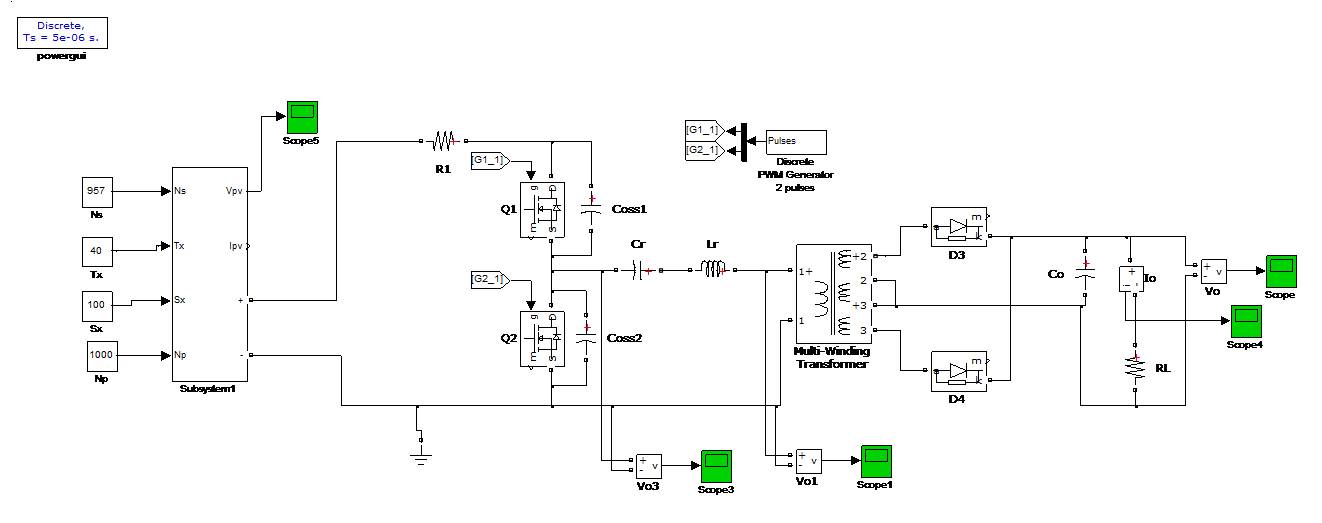
In this paper, a high efficiency solar array simulator (SAS) implemented by an LLC resonant DC-DC converter is proposed to save the cost and energy of photovoltaic (PV) system testing. The proposed converter has zero voltage switching (ZVS) operation of the primary switches and zero current switching (ZCS) operation of the rectifier diodes. By frequency modulation control, the output impedance of an LLC resonant converter can be regulated from zero to infinite without shunt or serial resistors. Therefore, the efficiency of the proposed SAS can be significantly increased. The circuit operations are analyzed in detail to derive the theoretical equations. Circuit parameters are designed based on the practical considerations. Finally, an illustrative example is implemented to demonstrate the feasibility of the proposed SAS.